Showing posts with label Michelle Williams. Show all posts

Wednesday, December 14, 2011

My Week With Marilyn (2011) - Directed by Simon Curtis


I have been traveling and working in the UK for the last four weeks. As I write this, I am entering into my final week of this trip. I have spent time working with many wonderful British people as well as getting a deep dose of the culture here and the work ethic. I also had the privilege of spending some time traveling around the country on some days off, taking in the beauty of the Lake District and even Scotland before the snow fell. It was wonderful to have this experience. However, I’ve also at times felt like a fish out of water. One of the great challenges to being in another country once the sightseeing stops, is to try to function within normal society. I haven’t encountered any other Americans on this trip (perhaps a good thing), which added to the feeling of being different. Maybe it’s the time of year or the poor economy, but it has been interesting to be the “only American” around. I’ve felt like the odd one out, speaking with an American accent at the grocery store or the mall doing ordinary things where tourists don’t normally venture. Today, in fact, I went somewhere that tourists don't normally go: I went to the cinema and saw Simon Curtis’ My Week With Marilyn.  Not only is it a brilliant entertainment and a superb fantasy, but I found a catharsis and sympathy in Marilyn’s plight, as she too was a fish out of water in this story involving her coming to England to shoot a rather ill-fated film with actor/director Laurence Olivier.


My Week with Marilyn is based on the diaries and memoir by Colin Clark, “The Prince, the Showgirl, and Me” and "My Week With Marilyn"(he was 3rd Assistant Director on The Prince and the Showgirl), where he recounts his short-term, but supposed deep connection to the most famous of movie stars: Marilyn Monroe, played with pure conviction here by Michelle Williams. In 1956, she embarked on a project with Laurence Olivier (played by Kenneth Brannagh), pairing the two of them in The Prince and the Showgirl (1957), with Olivier in fact behind the camera as well as in front. Olivier's film is a rather bland confection, but Clark’s memoir (he was 3rd Assistant Director on the film), and My Week With Marilyn, documents the story of Monroe’s difficulty to work with Olivier during the production, her troubles with her new marriage to Henry Miller, and the rather odd and fortuitous (for Clark) relationship with the young Clark during the making of the film. Many of the best and most interesting scenes in the film involve Marilyn, her Method acting coach Paula Strasberg (Zoe Wanamaker), and Olivier as they fuss and fight over work styles. For fans of classic cinema, these scenes are absolutely delicious fun.


I don’t normally go for films like this. I found last year’s The King’s Speech (2010) to be rather as expected, not containing many surprises. There might be something more to My Week With Marilyn though. This is not a “biopic”, which is usually meant to portray the entire life and breadth of a key figure. Instead, this film captures a short term glimpse of a star and is not subjective to the baggage of normal biopics, with the usual length and sogginess that comes with trying to capture everything. This is a film from Clark’s perspective looking at Marilyn Monroe, not the internal perspective of Marilyn looking outward. We never really encounter Marilyn except in the presence of Clark, or sometimes Olivier as well. In this way, Marilyn remains at a distance from us just as initially Clark is at a distance from her. When Clark is brought inter her inner circle, we have the privilege of going there with him. It is the paralleled point of view of Clark and the audience that maintains this important synergy. What in fact makes the movie succeed is this rather strict and intentional point of view that allows the audience to maintain a link with the subjective source of the material, rather than become distanced as objective observers of the proceedings. Clark is a rather blank canvas of sorts. We project ourselves into his shoes and we become Clark through this point of view. It’s not that we are flies on the wall. We are, in fact, this young man. He, in essence, lived out what millions of people would consider their greatest fantasy: to spend intimate moments with a mega star. Be it Marilyn Monroe, Greta Garbo, Michelle Williams (or whomever), there surely are times when moviegoers or fans have dreamed about what it would be like to meet such a person. I’ve wondered myself what it would be like if I could go back in time and have lunch with Garbo. What would I say? What would I do? My Week With Marilyn allows us to realize such a fantasy and put us right in the middle of it. Of course, what's in it for Marilyn? It's all mostly a trifle with nothing behind it. She is directionless, drugged, and utterly tragic and despairing. Clark gets to enact his rather selfish fantasy. But, Marilyn remains the exploited one in all of this. Where is her solace to be found?


Of course here is where we must have a discussion of Michelle Williams. I’m beginning to wonder whether I should turn my entire blog into a Michelle Williams fan page as I’ve already written about her glorious acting in Blue Valentine (2010) and Meek’s Cutoff  (2010) and my vote of approval at this point is rather redundant. However, I must admit that normally when I see an actor or actress take a role such as this, I tend to think of it as a sellout. In this case though, I feel like Williams has paid her dues. She’s done the indie films and the small pictures and created tremendous work along the way. Thus, I think she deserved this role and the chance to shine for the masses. I think Williams has earned all the accolades she will get for this role. Whether it’s her greatest performance or not isn’t a point to bicker on. It will likely be her iconic performance though. It will be the one she is remembered for by most people many years from now. As Monroe, Williams rightly stays far from any sense of caricature. She doesn’t play it too big, which allows the audience to sympathize with her humanity, and there is a deep humility and respect at the core of the performance that provides a transparency even though Marilyn remains rather enigmatic. It’s brilliant stuff all the way.


Whether all of this really happened back in 1956 is beside the point. The conceit works whether it’s truth or fiction. I would probably be so inclined to believe that with decades in hindsight, Clark’s memoir (which I haven’t read yet) would be highly subjective to the haze that envelope memories as they grow old. I actually think the film tends to capture the golden glow of such memories to the point that the film is rather absurdly glossy. This is not a flaw. On the contrary, if the film were to enact a greater sense of importance or realism, it could have become far too soggy. By keeping the glossy and glowing look, it gives greater weight to the subjective point of view and perspective, and I personally could care less whether the story is true or completely fabricated. It works cinematically, and that's my main concern. Although it’s clearly not the best film of the year, it is one of the best films of its kind and in my world there is room for films like this.

Wednesday, October 26, 2011

Meek's Cutoff (2011 U.S. Release) Directed by Kelly Reichardt


Tuck what is called Meek's Cutoff...a bad cutoff for all that tuck it. ...I will just say, pen and tong will both fall short when they grow to tell of the suffering the company went through.
-Samuel Parker, 1845


As Meek’s Cutoff opens, we see water. Cool, rushing water, providing a cleansing and peaceful sound. We see a group of pioneers trying to ford the river, up to the top of their wagon wheels in water. Up to their shoulders in water as they wade across, they linger nearby and fill up their buckets. They are lost, but at least they have water. Question is, when will they find more? Meek’s Cutoff is based on a true story that was documented in 1845 as a group of pioneers decided to hire Stephen Meek, a guide and trapper to lead them on a shortcut through central Oregon, to lead them to the Willamette Valley. He ended up getting them lost, wandering around the south-central deserts of Oregon as their water supply and patience wore out.


I consider myself predisposed to enjoy this film. Michelle Williams is just about my favorite actress working today, and Kelly Reichardt’s previous film, Wendy and Lucy (2008), was one of my top 5 films from that year. This film confirms what I’ve been noticing and that is she is one of the most talented and promising American filmmakers working today. She’s made three recent films, Old Joy (2006), Wendy and Lucy (2008), and Meek’s Cutoff that are all set in Oregon and all concern a certain wandering and searching. I think that she’s becoming increasingly assured in her abilities and the stakes have continued to increase in each film. Images throughout Meek's Cutoff are continually impressive, stark and realist. Yes the images are beautiful, mainly because it captures raw landscape. But the landscape is threatening and it’s as harsh as terrain gets, with no water in sight as our troupe walks across dry lake beds and dusty hills barren of any trees.


Williams plays Emily Tetherow, wife of Solomon Tetherow. There are two other couples with them, each with their own wagon. Emily Tetherow is a fascinating character to watch. Her stern and dirtied face is able to appear harsh and tough enough to compete with Stephen Meek, whom it’s clear she derides and blames for their plight. It’s also clear she holds some blame for the men in the troupe, as the women are never included in the discussions on what should be done with Meek and what they should do next. At one point in the film, the troupe captures a Native American and decides he might be the one to lead them to water. Emily does some kind things for him: feeding him, mending his moccasin, protecting his life. Yet it’s for realistic reasons she does this: She wants something in return from him and wants him to pay them back. I found this character development to be terrifically truthful. Williams plays the character straight and tough without a hint of weakness, able to draw a gun much quicker than the men appear able to.


Much has been made of the fact that Reichardt chose to film in standard aspect ratio, rather than widescreen. I’ve read reviews that have commented on this by claiming that Reichardt achieves some sort of claustrophobic effect or profound tension through this artistic choice. I couldn’t disagree more. I maintain once the film starts, you forget the film isn’t in widescreen. If the argument is made that the aspect ratio here provides claustrophobia, then we should be saying that other Westerns like Stagecoach (1939) and Shane (1953) are as well since they’re in the same ratio, something I would find preposterous. It also wasn’t that long ago that we all had square TVs and watched pan-and-scan videos. Did it feel claustrophobic to watch films then? This is not to say the choice was uncalculated. In fact, what I think the ratio provides is more realism, which is essential to the film’s feel.  Widescreen photography lends to the greater capacity of creating compositions, and the wider the screen, the more elaborate the compositions can be. Compositions do not feel realist in principle, they can feel manipulative, as if the hand of the director or cinematographer can be felt as he placed everything just so. Having a smaller field of vision limits the potential for compositions and I think that’s why Reichardt chose it. I also think it’s effectively done and one of the reasons for the film's success. You will almost never see the groups of men and women framed together. They are nearly always framed separately, because the camera doesn’t allow them to be framed together. With the men and women often separated, it highlights how women were probably not included in these types of conversations that men had. As viewers, we’re often watching the film from the women’s point of view as we watch the men talking from a distance. Reichardt also places most of the film’s emotion, as little as there is, on the shoulders of the women. She clearly wants us to see things as they do.


Meek’s Cutoff works so well because it’s such a deep meditation on quiet desperation. This film contains none of the tropes that cinema uses to trump up desperation or desolation, particularly in Westerns. There are no gunfights, fisticuffs, or even loud verbal wars between people. Mostly the film lingers on the mounting escalation of dread amongst the attempts at perseverance and hope. As things look bleaker and no water is found, hope begins to fade and desperation comes more to the fore. Yet it’s always restrained and cold, and the film forces you to stay in that place, providing no exposition or conclusion, confronting you with the eternal consequences of choice. In tone and execution, Reichardt’s obsession with quiet desperation seems to be her inspiration. It’s clearly what drives Old Joy and Wendy and Lucy, and is the main focus in Meek’s Cutoff. I’m reminded of the films of Ozu, Melville, and Bresson, but Reichardt is less interested in providing any redemption or conclusion to her stories. In more recent times, Van Sant’s trilogy of Gerry (2002), Elephant (2003), and Last Days (2005) are echoed a bit in Reichardt’s films, but again, Reichardt’s insistence on less cinematic intrusion and more realism separates her. This is a beautiful and memorable film from a unique voice.

Monday, October 3, 2011

Michelle


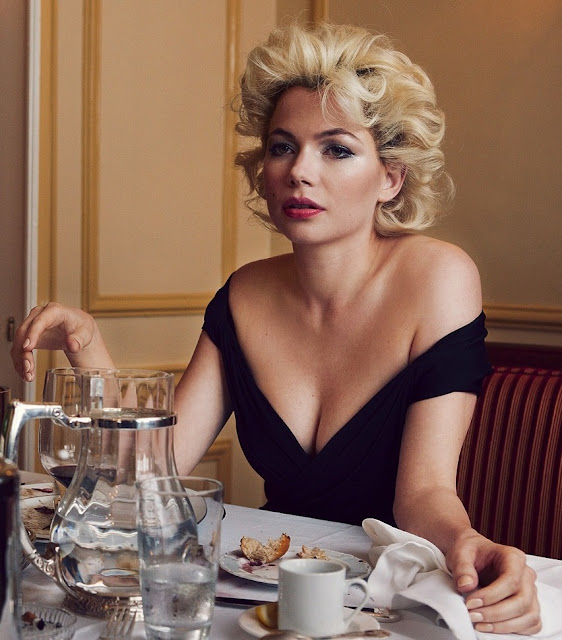
Michelle Williams as Marilyn Monroe. How could My Week With Marilyn not be good?

Sunday, May 22, 2011

Blue Valentine (2010) - Directed by Derek Cianfrance


"A relationship, I think, is like a shark, you know, it has to constantly move forward or it dies, and I think what we got on our hands is a dead shark."
Woody Allen- Annie Hall (1977)

Woody Allen's quote seems to apply to the marriage central to Blue Valentine. Cindy (Michelle Williams) has moved forward with her life, but Dean (Ryan Gosling) has not followed suit and is not joining her on the path. He has remained stagnant, inert and content with the status-quo. She is more ambitious and regretful, dragged down by his malaise, seemingly preventing her from bettering herself. He wants things to be normal and the way they’ve always been. She saw marriage as just the beginning. He saw marriage as the final goal and is content with that. Dean and Cindy’s relationship is kind of like an egg yoke at this point in time: the slightest pressure is applied and it runs all over the place.


Derek Cianfrance’s film concerns Cindy, Dean and their daughter Frankie, who’s caught in the middle of a marriage crumbling beyond repair, one that is wallowing in a state of paralysis. Cindy and Dean drop off Frankie at the grandparent’s house and Dean convinces Cindy to stay at a “love” motel in order to rekindle and reconnect. This film documents basically a 24 hour span of time through the night into the next morning as they reach a point of no return in the relationship. During this time, they clash with each other sexually, physically and emotionally. Present scenes of bitterness, misunderstanding, hatred and regret are intercut by scenes of the beginning of their relationship, ones of tender, funny, awkwardly romantic moments that make the present scenes all the more poignant and painful in my opinion. 


This is a film that truly cares for its characters despite their flaws and inabilities. They are both equally sympathetic and unsympathetic at times and yet the film genuinely feels for them. I found that I was invested in the outcome whether Cindy and Dean deserved it or not. Cianfrance chooses to film the "past" scenes with a more open-eyed optimism. Scenes are bright, clear and infused with a joy and improvisation. "Present" scenes are darker and murky, cluttered in the frame and rarely do we ever see both characters in a two-shot. They are isolated and disconnected from each other both in the frame and in their lives. Cianfrance infuses the whole film with a tone I will describe as achingly mournful. This tone at times can be sentimental and nostalgic, but with a realism that belies any thoughts of melodrama. We are only given the beginning and the end of the relationship, not the complete middle section. This is not a flaw but a trusting of the audience. Do we really need to see the entire middle of their marriage where it slowly disintegrates? Can’t we fill in the gaps ourselves? We don’t need to be pandered to and Blue Valentine gives us the benefit of the doubt.


Ultimately, this is a film that succeeds on the talent of its leads. I’ll admit I came into this film already a huge fan of both Ryan Gosling and Michelle Williams. They are two of my favorite actors working today. Gosling brings great presence and intensity to films like Half Nelson (2006) and Lars and the Real Girl (2007). As for Michelle Williams, I’ll go so far as saying that I think Michelle Williams might be the best American actress working today, and possibly the best anywhere, with Amy Adams and Britain’s Carey Mulligan making a run for that title as well. Williams has been absolutely remarkable in a string of films going back to Brokeback Mountain (2005). She has brought truth, clarity, and credibility to roles in Shutter Island (2010), Synechdoche, NY (2009), and Wendy and Lucy (2008). I can’t wait to see her in the new film Meek’s Cutoff (2010). Blue Valentine is a showcase for her incredible range. What I notice about her acting, is that I don’t notice it. She never seems like she’s trying very hard and you can’t “see” the acting. She just is the character and that’s that. You’re never thinking there is a false move and she totally gets it. She can do comedic, lighter moments and terribly emotional ones without ever seeming like she’s forcing it. One scene where Dean and Cindy meet on a bus and Dean is trying to ask her out is probably the best showcase for both Gosling and Williams. Gosling is the awkward guy, trying to be cool but sounding stupid. Williams plays it cautiously and reserved, trying to avoid making eye contact and yet cannot resist his bumbling courtship. I’m not normally a big fan of actor movies, preferring the director’s talents to the actor’s, but this one is undeniably great because of the acting. I think that’s what makes this film so painful and wrenching to watch at times. Both Gosling and Williams are so real, likable and watchable that it pains us to watch them as these people who just can’t function together. As an audience, Blue Valentine puts you through the wringer. It's intense, honest and tends to be a downer, but I found the truth contained to be well worth the journey.