Showing posts with label John Cassavetes. Show all posts

Wednesday, May 9, 2012

Faces (1968) - Directed by John Cassavetes


In my newfound appreciation (or tolerance) of Cassavetes, I have begun to understand something. Arduousness can itself be something which allows material to develop, elevate, and enlighten a particular theme or emotion. Here we have again another example of Cassavetes drawing out impact through sheer, sustained discomfort for the viewer. For me, this film is not something enjoyable to sit through, but rather a test of wills for me that is then rewarded in the end by a heightened state of emotional response. Through bludgeoningly tiresome dialogue and lengthy scenes, Cassavetes seemingly alienates his audience in the first half. Those that remain through the end of the film, though, are rewarded with one of the great hours of American independent cinema.


Plot here is not so important. Faces regards a middle-aged married couple, Richard (John Marley), and Maria (Lynn Carlin). They have drifted apart and this film basically picks up at the point in which Richard asks her for a divorce. In fact, once he makes his request, she can do nothing but laugh. Perhaps she’s so shocked and relieved that she finds it funny. Both Richard and Maria will end their night in the arms of someone else and this film examines the pit into which the modern marriage has disintegrated into. Malaise, unhappiness, frustration, loss of purpose……it’s all here in achingly painful and tedious detail.


I’ll admit, the first hour is nearly impossible to watch. I found it disorienting, sloppy, annoying in the worst way. I was not prepared, though, for how well everything would come together in the second half. Of particular note, is the lengthy scene when Maria and her girlfriends go to the club, and bring home a gigolo (Seymour Cassel) and concluding with the morning after sequence. Each woman is married and all are flirting in their own way with him. It’s apparent though, only one woman has real intent to have sex with him…..Maria. Her eyes tell the whole story. This sequence, of the women making fools of themselves, of the painfully humiliating discussions and opinions, of the girlfriends one by one exiting the house, leaving Maria and the man alone is absolute brilliance and Cassavetes at his very best. Of course, the morning after includes a further extending of the pain and desperation on display. It’s simply astounding filmmaking and raw emotion at its most heightened. This final hour of the film took my breath away.


Faces is filled with tremendous performances from many involved. John Marley, Lynn Carlin, Gena Rowlands, and Cassell all come off great here. But it's Carlin who takes the prize as the best performance in the film. She breaks my heart and is achingly honest. Cinematography, in 16mm, by Al Ruban, Maurice McEndree and Haskell Wexler is remarkable for its ability to exude harshness and beauty at the same time. If I have any complaint toward the film, its that the length and uneven quality of the film tends to create too much emphasis on the second half. And yet, I’m not really sure that this is a fair complaint. I wonder if the despair of the second half would be as impactful without the drawn out male-female interactions of the first half that seem to go nowhere. It's as if the tension building from the beginning sees it's release by the end. I can't help but think that Cassavetes knew his pacing was difficult to watch, but the only way to get his points across. Yes it’s arduous to sit through, but Faces is incredibly potent.

Wednesday, May 2, 2012

A Woman Under the Influence (1974) - Directed by John Cassavetes


I’ll admit right out of the gate that Cassavetes has not been my cup of tea in the past. I saw Shadows (1959) several years ago and had a hard time focusing. I also watched The Killing of a Chinese Bookie (1976) and just really found it to be a nasty, ugly film. I understand that there are many who find these films to be masterpieces, but I didn't particularly like them. One film I've been avoiding is A Woman Under the Influence, which is considered to be one of Cassavetes’s best films and one of the watershed moments, especially in American Cinema of the 1970’s. I’ve been aware all along of the standing of Gena Rowlands’s performance as one of the best of that decade. Yet, I was still avoiding this film as I just really didn’t want to go through the ordeal of watching it. I came in with low expectations but came away with a high appreciation for it. It’s the first Cassavetes film that I can honestly say I appreciate, and in fact, applaud.


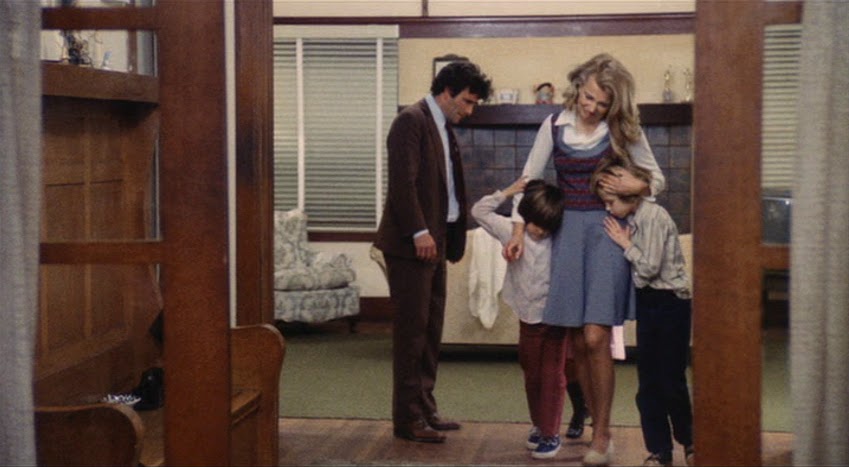
A Woman Under the Influence is a about a woman named Mabel (Rowlands), her husband Nick (Peter Falk), and their 3 children. To put it mildly- Mabel has issues. She drinks too much and is probably an alcoholic. She is also severely unstable and could probably be considered bi-polar or schizophrenic as well. She is a stay at home mom and her husband is a blue collar worker. This film is an examination of this woman and her relationships to her husband, her kids, her extended family and her connection/disconnection to reality. Cassavetes is less interested here in particular storylines and is focused on the psychological breakdown of Mabel and her familial incapacitation.  From the very beginning of the film we realize this woman is not right, and she’s going to get worse.


Of course the film’s impact is probably greater because of the way it’s filmed. I’ll be honest- this film was really difficult for me to sit through. It’s probably one of the most arduous films I’ve ever sat through, in fact. It’s long. It’s raw. It’s disjointed and at times clumsy, but I couldn’t look away from it. Watching a film that conveys the sorts of raw emotions this one does surely doesn’t stray too far from other directors who work with intense feelings, like Bergman. But, Bergman is far more composed cinematically and enwraps the viewer with a “comfortable presentation”. Cassavetes’s unsteady camerawork and grainy stock adds an ugliness to the already difficult proceedings. Even the way the compositions are put together are difficult to watch. People are not framed in their entirety. We get scenes of people that are filmed in close quarters, where people’s heads are not in full view, nor their bodies. We always see portions of people not their entire selves. Editing of course is also given short shrift. Scenes carry on and linger beyond that which is considered conventional. All of this adds a claustrophobia to the entire film. Even this, though, works towards the film's end goals. It feels part of the means to the end.


Because of how emotionally rough the film is, it’s hard to really know how to evaluate the performances because there is just so much that feels un-edited and rough. Rowlands is heartbreaking and annoying, true and false. She keeps you on your toes as you’re not sure what you’re going to see next, but sometimes I felt like I was watching a performance. At other times my heart was breaking for this woman. Peter Falk is tremendous, and probably a bit more consistent, but I’m not sure I always bought his interactions with his children. Taken together, I think the ordeal of watching this film is what stands out the most for me. It’s devastatingly uncomfortable and not like anything else I’ve ever seen and it's the intensity of the film that makes the biggest impact. I think it’s both flawed and a masterpiece at the same time, and really the full weight of the story isn’t felt until the final 20 minutes or so. I don’t think I’ll ever want to see it again, but I don't think I'll ever be able to forget it.