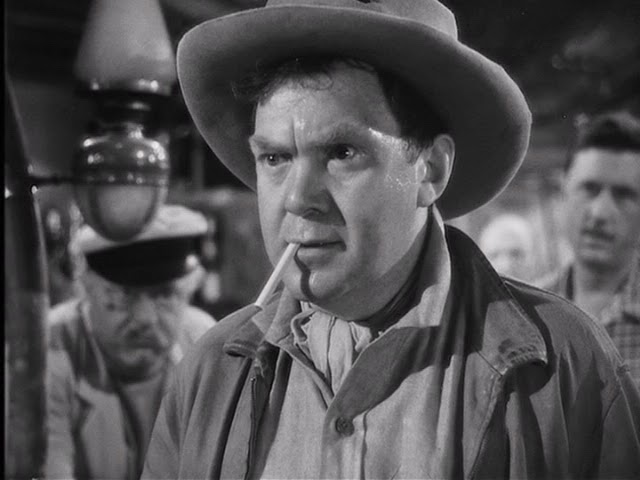
There’s something so effortless about Hawks’ Rio Bravo….something so utterly smooth about it. Watching it is like being caressed and hugged by something resembling a big warm “western blanket”. When you turn it on, there's this soothing cinematic romanticism, coupled with a professional suave that is irresistible. But there’s also Hawks and his wonderful sense of camaraderie and determination that he puts on display. You want to spend time with these people….Dean Martin, John Wayne, Angie Dickinson, Ricky Nelson and Walter Brennan because they are good people and there’s a dignity about them. Throughout the film's entire running time, one is treated to near perfect cinema with a cast of memorable characters and a script that has you grinning often. It’s got a bit of everything: great action, romance, comedy, pathos, fine music......one could go on.

John Wayne plays Sheriff Chance, who along with his other
deputies, Dude, the recovering alcoholic
(Dean Martin), and Stumpy, the crippled old man (a hilarious Walter Brennan) have
captured the murderous Joe Burdette (Claude Akins), who is brother to a nearby ranch owner. Chance and his deputies must patrol the town
and keep order until they can get Joe out of town to meet his justice. They
spend several days warding off various ranchers and hired guns who have an eye
to get Joe out of jail. In a charming subplot, a woman named Feathers (Angie
Dickinson) has arrived in town off the stage and begins to woo Chance with
come-hither looks and a no-nonsense attitude, turning Chance into something
resembling pudding. It’s a cute subplot that could only work in a Howard Hawks
film because he gives the people enough of a dignity to actually make us
care whether Chance and Feathers get together. Their wonderful interplay more
than justifies the inclusion of this plot element. Just to make things a bit more well rounded, a
young gunslinger named Colorado (Ricky Nelson) has come to town and although
initially shy of helping out Chance, soon comes around to helping him keep
the peace. It seems all rather straightforward, but the execution is simply perfection.


So we have this really nice cross-section of individuals coming
together to support each other in a cause. We have young and old, male and
female, able bodied and not so able bodied. Because of their determination and hard work together, they’re able to pull through in the end. This sense of determination and camaraderie
is so elemental to Hawks and his films. Think of Bringing Up Baby, His Girl
Friday, Only Angels Have Wings
and one can find this same sense of purposeful determination. John Wayne gives one
of his smoothest and most charming performances as Chance. He underplays so
nicely that sometimes you’re surprised at how genteel he is. Martin captures a
dark, self-destructive streak, and although I never found him to be a great
actor, he does well enough to make you believe he was a hot-shot deputy several
years before. Angie Dickinson gives a fun and well-timed performance, standing
up to Wayne nicely and not letting him overshadow their scenes together. Her
talkative and aggressive flirting is infectious. My favorite performance in the film would be from Walter Brennan though. He’s so funny and crotchety and whiny with
that domed hat and teeth missing. Half the time you don’t realize what he’s
said until he’s done saying it and moved on to the next thing already. I love the
moment where after throwing a stick of dynamite at the bad guys he says, “How
do you like THEM apples?!”

Rio Bravo is a film that basically all occurs within a short section of
town, as the plot hops back and forth between the sheriff’s office and the saloon/hotel. It’s kind of odd, but the way that we become familiar with the surroundings and with the
sets begins to feel somewhat comforting after awhile, even though you hardly
ever move on from the sets. Another interesting element is the long running
time. At 141 minutes, the film doesn’t feel so much epic, as it does lived-in.
With the long running time, Hawks is able to develop the dialogue, rhythm and
interactive dynamics that are so emblematic of his work. This simply requires
time and space and it can’t be rushed or earned any other way. I can’t imagine the film
without the breathing spaces, the off-handed comedic moments, and the seemingly
innocuous moments that add up to something greater than their parts. The sum of
these parts is clearly one of the greatest westerns of all time.